.png)
Application Guide

Recruitment & International Education Specialist, Malta
Outreach Recruitment has guided 2,000+ international students through every stage of the Malta study journey — from programme selection and visa applications to finding accommodation and part-time work. Our advisors are based in Malta and work exclusively with accredited institutions.
By Outreach Recruitment Agency · Published April 2026 · Updated June 2026 · 9 min read
Malta is rising as Europe's most accessible English-language study destination for international students. With EU-recognised degrees, tuition fees from €5,000 per year, and the legal right to work 20 hours per week during term, students from over 60 countries now choose Malta over higher-cost alternatives in the UK and the Netherlands.
Ready to Study in Malta?
Apply Now →Malta is one of only two EU member states — alongside Ireland — where English is an official language. Every accredited university and college on the island teaches entirely in English, with no language requirement beyond standard IELTS or TOEFL thresholds.
For students from anglophone Africa, South Asia, Southeast Asia, or the Caribbean, this is a decisive factor. You study in the language you already know, inside a legal and academic environment that mirrors the UK and Ireland — but at a fraction of the cost.
This also means your degree is internationally legible. Employers in the UK, Canada, Australia, or across the EU can read your Maltese transcript without translation. You graduate with documentation in the world's most widely used professional language.
Unlike studying in Germany, where many programmes require B2 or C1 German proficiency, Malta imposes no such barrier. Non-native English speakers who meet IELTS 5.5–6.5 — depending on the institution — are eligible to apply directly.
Malta's small size reinforces this advantage. English is used in everyday life: in shops, offices, and government services. You are not just studying in English — you are living in it from day one. That total immersion accelerates language confidence and professional fluency faster than any course in a non-English environment.
For a complete overview of everything available, read our Study in Malta guide or explore the full Malta Study Guide.
A Bachelor's degree in Malta costs between €5,000 and €12,000 per academic year. A Master's degree costs €6,000 to €15,000. Both are significantly lower than comparable programmes in the UK, Ireland, or the Netherlands — and these degrees carry full EU recognition valid across all 27 member states.
This means a diploma from an accredited Maltese institution is accepted for employment, professional licensing, and further postgraduate study anywhere in the EU — from France and Germany to Sweden and Romania. You are not limiting your future to Malta: you are opening it to an entire continent.
For comparison, the same accredited degree in the UK now costs non-EU students £22,000–£38,000 per year. In Ireland, fees range from €10,000 to €25,000. In Malta, you get the same EU-recognised outcome at a lower price, in English, with better weather and a lower cost of living.
| Country | Bachelor's (avg/year) | Master's (avg/year) | English taught |
|---|---|---|---|
| Malta | €5,000 – €12,000 | €6,000 – €15,000 | ✅ Yes (official language) |
| United Kingdom | £22,000 – £38,000 | £15,000 – £30,000 | ✅ Yes |
| Ireland | €10,000 – €25,000 | €10,000 – €20,000 | ✅ Yes |
| Netherlands | €8,000 – €20,000 | €10,000 – €22,000 | ✅ Many programmes |
| Germany | €500 – €3,000 (state unis) | €500 – €5,000 | ⚠️ Limited; German required |
The Maltese government supports higher education through MFHEA (Malta Further & Higher Education Authority), which accredits institutions and enforces quality standards equivalent to the UK's QAA framework. When you choose Malta, you choose a regulated, audited, quality-assured system.
To see what's available, browse available programs directly on our site.
International students on a valid student residence permit in Malta are legally permitted to work up to 20 hours per week during term time, and full-time during official academic breaks. This is one of the most student-friendly policies in the EU.
Working 20 hours per week at Malta's national minimum wage (€8.24/hour as of 2025) generates roughly €660 per month — enough to cover a shared room in Msida, Gzira, or Birkirkara, with money left over for food and daily expenses. Many students in hospitality, tourism, retail, and tech earn above minimum wage.
This matters for two reasons beyond the financial one:
Outreach Recruitment actively connects students in business management, hospitality, digital marketing, and IT with employers who understand and work within the 20-hour weekly limit.
EU and EEA citizens do not need a student visa to study in Malta — they exercise freedom of movement. Non-EU students must apply for a student residence permit from Identity Malta. The process is straightforward when your documents are in order.
Processing time is approximately 4–6 weeks. Outreach Recruitment prepares your complete visa documentation pack, reviews it before submission, and liaises with Identity Malta on your behalf. Students who apply through us report fewer requests for additional documents and faster approvals.
The permit is renewable each academic year and grants you the right to work 20 hours per week. For full details, read our Malta Student Visa Complete Guide.
| Requirement | EU / EEA Citizens | Non-EU Citizens |
|---|---|---|
| Student visa / permit | Not required | Student Residence Permit (Identity Malta) |
| Right to work | Unrestricted | 20 hrs/week during term; full-time in holidays |
| Tuition fees | Same as non-EU at private institutions | Same — no surcharge at most Maltese institutions |
| Health coverage | EHIC accepted | Private health insurance required |
Malta has a focused higher education sector with a small number of accredited institutions, each offering a distinct range of programmes. The University of Malta is the flagship public university. Several private colleges and English language schools also hold MFHEA accreditation.
| Institution | Type | Key programme areas | Level |
|---|---|---|---|
| University of Malta | Public | Medicine, Law, Business, IT, Arts, Sciences | Bachelor's, Master's, PhD |
| MCAST | Public | Engineering, Hospitality, IT, Digital Media | Diploma to Bachelor's |
| American University of Malta | Private | Business, Engineering, Architecture, Computing | Bachelor's, Master's |
| St Martin's Institute of IT | Private | Computer Science, Software Engineering, AI | Bachelor's, Master's |
| IELS Malta / EC Malta | Language school | General English, IELTS Preparation, Business English | Certificate / Intensive |
Each institution is accredited by MFHEA and subject to external quality review. All degrees carry full recognition within the European Qualifications Framework (EQF), making them portable across the EU.
Outreach Recruitment works directly with accredited institutions in Malta. View all study programs in Malta or speak with an advisor to find the right fit for your goals and budget.
Students in Malta typically budget €600–€900 per month for living costs. This covers shared accommodation, food, local transport, and mobile data — but not tuition fees or travel home.
Accommodation is the largest expense. Shared student apartments in Msida, Gzira, and Birkirkara — areas close to the University of Malta — range from €350 to €550/month for a private room. Sliema and St Julian's are more expensive (€500–€700/month) but popular with students in hospitality who work nearby.
Malta's public bus network is free for students enrolled at accredited institutions — a Tallinja card is issued on registration. Eating out in casual restaurants costs €8–€15 per meal; weekly supermarket shopping runs approximately €40–€60.
| Category | Monthly cost (approx.) |
|---|---|
| Shared accommodation (Msida/Gzira) | €350 – €550 |
| Food and groceries | €150 – €250 |
| Transport (bus — free with student card) | €0 |
| Mobile phone & internet | €15 – €30 |
| Personal spending / leisure | €80 – €120 |
| Total (estimate) | €595 – €950 |
For a full breakdown, read our guide on the cost of living in Malta as a student.
Malta offers students something that cost comparisons cannot capture: quality of life. Over 300 days of sunshine per year, a safe and walkable urban environment, clean Mediterranean seas within 20 minutes of any campus, and a culture that genuinely welcomes newcomers from all backgrounds.
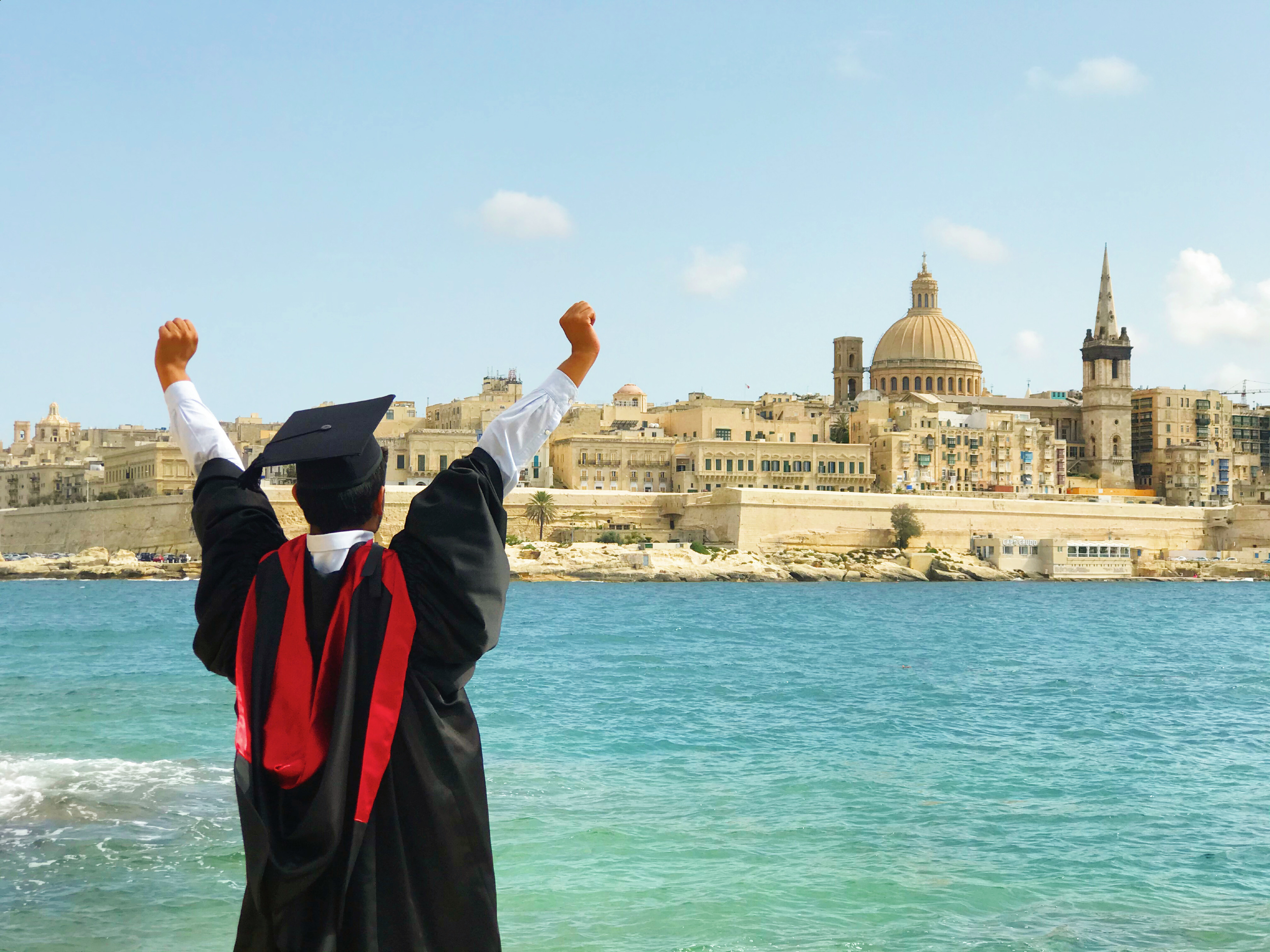
The country is small — 316 square kilometres — which means everything is reachable. Students can explore ancient Neolithic temples, the fortified capital Valletta (a UNESCO World Heritage Site), and the sister islands of Gozo and Comino on a weekend. The island's scale means students avoid the anonymity of large European capitals and report feeling at home within weeks.
Safety is a consistent concern for international students. Malta ranks among the safest countries in the EU. Violent crime is rare; the healthcare system provides a solid baseline for students with valid health insurance; and the public transport network is reliable and free for registered students.
Malta's economy has diversified significantly in the past decade. The country is now a hub for iGaming, fintech, and maritime services. Students in business, digital media, IT, and hospitality find Malta increasingly relevant as a career launch point — not just as a study base.
Applying to study in Malta involves five main steps: choosing a programme, submitting your application, receiving an acceptance letter, applying for your student visa or permit, and arranging accommodation. Outreach Recruitment handles all five with you, at no cost.
The full process from first enquiry to landing in Malta typically takes 8–12 weeks. Start early — especially if you are applying from outside Europe, where courier times for original documents can add 1–2 weeks. For a detailed walkthrough, read our step-by-step guide to applying to study in Malta.
★★★★★"Moving to Malta to study Business Management was the best decision I made. The English-taught programme matched what I had studied in Nigeria, the tuition was affordable, and I found part-time work in a hotel within my first month. Two years later, I have a full EU work permit and a management role."
★★★★★"I compared Malta with Germany and the Netherlands. In Germany I needed B2 German to access the programmes I wanted. In Malta, I started my Computer Science degree immediately in English. Living costs were lower than expected and Outreach handled the student visa process — zero stress."
★★★★★"The quality of life in Malta surprised me the most. I came for the degree but stayed because of the community. The island is safe, people are genuinely welcoming, and studying near the sea every day still feels like a privilege. Outreach found me accommodation before I even landed."
Start Your Application Today
Apply to Study in Malta →Free Study in Malta Webinar
Join our free webinar and get expert answers about studying in Malta, visa requirements, and available programmes — from advisors based in Malta.
Register for the Free Webinar →Explore Study Programs in Malta
Browse Bachelor's, Master's, and English language programmes available to international students in Malta.
Browse All Programs →للطلاب الناطقين بالعربية
مالطا وجهة دراسية أوروبية متميزة للطلاب الدوليين، حيث الإنجليزية لغة رسمية والشهادات معترف بها في جميع دول الاتحاد الأوروبي السبعة والعشرين. الرسوم الدراسية تبدأ من 5000 يورو سنوياً، وتكاليف المعيشة معقولة مقارنة بالدول الأوروبية الأخرى. يحق للطلاب الدوليين العمل 20 ساعة أسبوعياً خلال فترة الدراسة. تواصل مع أوتريتش للتوظيف للحصول على إرشاد مجاني حول البرامج الدراسية وإجراءات تأشيرة الطالب.
Pour les étudiants francophones
Malte est une destination d'études européenne idéale pour les étudiants internationaux : l'anglais est langue officielle, les diplômes sont reconnus dans les 27 États membres de l'UE, et les frais de scolarité commencent à 5 000 € par an. Les étudiants non-européens peuvent travailler jusqu'à 20 heures par semaine pendant les cours. Contactez Outreach Recruitment pour un accompagnement gratuit dans le choix de votre programme et la constitution de votre dossier de visa étudiant.
Malta offers EU-recognised English-taught degrees at lower costs than the UK, Ireland, or Netherlands. Students benefit from a safe Mediterranean lifestyle, the legal right to work 20 hours per week, and a straightforward student visa process. All degrees are valid across all 27 EU member states.
Tuition fees in Malta range from €5,000 to €12,000 per academic year for a Bachelor's degree, and €6,000 to €15,000 for a Master's. Living costs average €600–€900 per month, covering accommodation, food, and transport.
EU citizens do not need a student visa — they exercise freedom of movement. Non-EU students must apply for a student residence permit from Identity Malta. You need an acceptance letter, proof of funds, health insurance, and proof of accommodation. Outreach Recruitment prepares the full documentation pack on your behalf.
Yes. International students on a valid student residence permit can work up to 20 hours per week during term time and full-time during official academic holidays. At Malta's minimum wage, 20 hours per week generates approximately €660/month — enough to cover accommodation in shared housing.
Yes. Degrees from MFHEA-accredited Maltese institutions are fully recognised within the European Qualifications Framework and accepted across all 27 EU member states for employment, professional licensing, and further study. The University of Malta and MCAST are both EU-recognised institutions.
All accredited universities and colleges in Malta teach in English. Malta is one of two EU member states — alongside Ireland — where English is an official language. No Maltese language proficiency is required to study or live in Malta.
The student residence permit application takes approximately 4–6 weeks to process from submission to Identity Malta. Allow 8–12 weeks total from your initial application to arrival in Malta — especially if original documents need to be couriered from outside Europe.
Malta is not a compromise. It is a strategic choice for international students who want EU-recognised qualifications, affordable tuition, English instruction, and the right to build European work experience while they study — all in a safe, welcoming, and genuinely beautiful place to live.
The island's rise as a study destination reflects deliberate investment in higher education quality, a welcoming visa framework, and a cost structure that makes a European degree genuinely accessible to students from Africa, Asia, the Middle East, and Latin America.
If you are comparing Malta to the UK, Ireland, or the Netherlands, the key question is not "is Malta as prestigious?" — it is "does the degree achieve the same outcome?" For most students, the answer is yes: an MFHEA-accredited degree from Malta opens the same EU employment and professional licensing doors as any equivalent European qualification.
To learn more, read our complete guide to studying in Malta or the full Malta Study Guide for resources on visas, costs, accommodation, and programmes.
Ready to Start Your Journey to Malta?
Apply Now — It's Free →Still have questions? Join our free webinar.
Our Malta-based advisors answer live questions on student visas, tuition fees, accommodation, and part-time work rights. Register for free.
Join Our Free Study in Malta Webinar →Browse all study programmes in Malta
Compare Bachelor's, Master's, and English language programmes by institution, subject area, and annual cost.
View All Study Programs in Malta →