- As of 17 November 2026, Outreach Recruitment lists 131 open jobs in Malta; the largest category is Engineering & Maintenance with 29 roles.
- 31 of our open roles publish a salary, ranging from €16,800 to €70,000 a year (gross); 14 new jobs were added in the last 14 days.
Key Takeaways
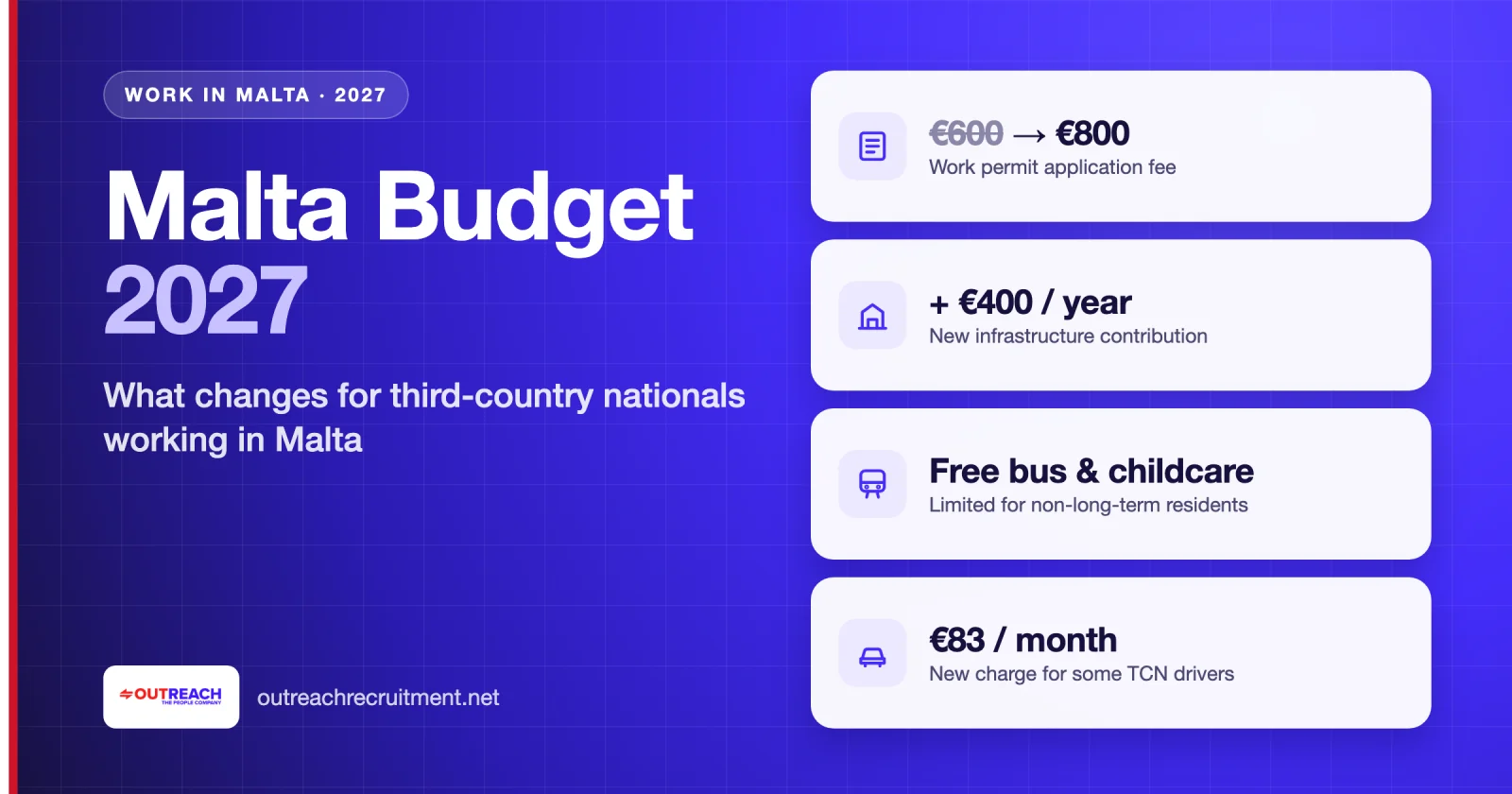
- New work permit applications for non-EU workers rise from €600 to €800 per person.
- A new €400 annual infrastructure contribution applies to new applicants and on renewals. Minors are reported to be exempt.
- From January 2027, free public transport is limited to Maltese citizens, EU citizens living in Malta and long-term residents.
- From 2027, new applicants without long-term residence no longer qualify for free childcare. Children already enrolled are not affected straight away.
- Non-EU driving licences can only be used for 12 months from entry, and a new €83 monthly charge will apply to certain TCN drivers.
- The Atypical In-Work Benefit will be paid only to Maltese citizens, EU citizens and long-term residents.
- Most measures still depend on final implementation rules, so dates and details may change.
What Budget 2027 Means for Third-Country Nationals
Malta's Budget 2027 was presented by Finance Minister Clyde Caruana in October 2026. A large part of it deals with third-country nationals: workers from outside the EU and EEA who live and work in Malta on a single permit.
The Government says Malta needs to rely less on recruiting foreign workers. To do that, it is raising the cost of bringing in new workers and limiting some free public services to Maltese citizens, EU citizens and long-term residents. The Government expects the TCN measures to bring in around €46 million in extra revenue.
If you already work in Malta, or plan to move here for a job, these changes can affect your monthly budget. Below is a plain-English summary of each measure.
| Area | What changes | Who is affected |
|---|---|---|
| Work permit fee | Rises from €600 to €800 per new application | New non-EU workers and their employers |
| Infrastructure contribution | New €400 charge each year, on application and renewal | New applicants and TCNs renewing their permit |
| Public transport | Free travel limited from January 2027 | TCNs without long-term residence |
| Childcare | Free childcare limited from 2027 | New applicants without long-term residence |
| Driving | 12-month limit on non-EU licences; €83 monthly charge | Certain TCN drivers |
| Atypical In-Work Benefit | Paid only to Maltese, EU citizens and long-term residents | TCNs without long-term residence |
The Changes in Detail
Work permit fees: from €600 to €800
The fee for a new work permit application for a non-EU worker goes up by €200, from €600 to €800 per person. In Malta this fee is usually paid as part of the single permit application handled through Identità.
Many employers pay this fee when they recruit from abroad, but this depends on the employer and the contract. Ask your employer or recruiter who covers it before you sign.
New €400 annual infrastructure contribution
Budget 2027 introduces a new €400 infrastructure contribution. According to KPMG's summary of the Budget, it is an annual charge that applies both to new applicants and when a TCN renews their permit. Reports say minors are exempt.
This is on top of the work permit fee, so a new application could cost €1,200 in the first year (€800 fee plus €400 contribution).
Public transport: free travel limited from January 2027
Today, most residents in Malta with a personalised Tallinja card travel for free on public buses. From January 2027, free travel will be limited to Maltese citizens, EU citizens living in Malta and long-term residents.
TCNs without long-term residence will have to pay for bus travel. Early reports mention a charge of about €33 a month, but this figure has not been confirmed in the official Budget summaries. Check Malta Public Transport's fares before budgeting for it.
Childcare: no free childcare for new applicants without long-term residence
Malta's free childcare scheme helps working parents with day care costs. From 2027, it will only be available to Maltese citizens, EU citizens living in Malta and long-term residents.
New applicants who do not have qualifying long-term residence status will no longer be eligible. Children who are already enrolled will not lose their place straight away. They keep it until they stop qualifying under the scheme's normal rules.
Driving: 12-month limit and a new monthly charge
Two driving changes affect TCNs who live in Malta:
- Non-EU driving licences can only be used for up to 12 months from entry into Malta. Leaving Malta and coming back does not restart the 12 months. After that, you need a Maltese or EU licence.
- A new administrative charge of €83 per month will apply to holders of Category B and B1 licences issued or renewed from a date that is still to be confirmed.
There are exemptions. They include EU and EEA citizens, long-term residents and their spouses, certain UK, Australian and UAE citizens, and TCNs whose residence permit was issued for a job that involves driving, such as professional drivers.
For workers who already hold a permit, reports say the 12 months are counted from their last entry into Malta before 1 January 2027.
Atypical In-Work Benefit
The Atypical In-Work Benefit is a one-off payment for lower-paid private-sector employees who work weekends or late shifts. Under Budget 2027, it will be paid only to Maltese citizens, EU citizens and long-term residents. TCNs without long-term residence will no longer qualify.
Browse jobs in Malta now
See current vacancies across every sector Outreach Recruitment recruits for.
Browse jobs in MaltaWhy Long-Term Residence Matters More Now
Many of these changes depend on one thing: whether you hold long-term resident status. In Malta, as across the EU, long-term residence is usually available to non-EU nationals after about five years of continuous legal residence, if they meet the other conditions.
If you have lived in Malta legally for several years, check whether you can apply. It could keep your access to free transport, free childcare and the Atypical In-Work Benefit, and help you avoid the new driving charge. Identità handles these applications.
What This Means If You Want to Work in Malta
Malta still needs workers in hospitality, construction, healthcare, customer service, transport and many other sectors. Budget 2027 does not stop non-EU workers from coming to Malta, but it does make the move more expensive.
Before you accept a job offer in Malta, it helps to:
- Ask who pays the permit costs. Confirm whether your employer covers the €800 fee and the €400 annual contribution.
- Work out your real monthly costs. Include rent, bus fares, childcare and, if you drive, licence costs.
- Plan your driving licence early. If you need to drive, look into getting a Maltese licence within your first 12 months.
- Keep your residence history in order. Continuous legal residence counts towards long-term resident status later on.
- Work with a trusted recruiter. Outreach Recruitment can explain how a role works before you apply. Browse jobs in Malta.
What Employers in Malta Should Know
Employers who recruit from outside the EU will face higher costs for each new hire and each renewal. It is worth reviewing your recruitment budget for 2027, and being clear with candidates about which costs you will cover. A clear, honest offer helps you keep good candidates and stops them dropping out late in the process.
Many details, including exact start dates and how the €400 contribution will be collected, still depend on the final implementation rules. If you are planning 2027 hiring, see how Outreach Recruitment supports employers.
Important Note
This article is general guidance based on Malta's Budget 2027 announcements and published Budget summaries as of 29 October 2026. It is not legal or immigration advice. The measures still depend on final implementation rules and may change. For your own situation, check with Identità, Jobsplus or Transport Malta, or speak to a qualified adviser.
Sources: KPMG Malta, Budget 2027 highlights; MaltaToday, 26 October 2026.
FAQs
How much will a work permit cost in Malta in 2027?
Under Budget 2027, a new work permit application for a non-EU worker rises from €600 to €800. A new €400 annual infrastructure contribution also applies, so the first-year cost could reach €1,200 per worker.
Is the €400 infrastructure contribution paid every year?
According to KPMG's summary of the Budget, the €400 infrastructure contribution is annual. It applies to new applicants and on renewals. Reports say minors are exempt. Final rules on how it is collected are still to be published.
Will third-country nationals still get free bus travel in Malta?
From January 2027, free public transport will be limited to Maltese citizens, EU citizens living in Malta and long-term residents. Other TCNs will have to pay. Early reports mention around €33 a month, but this has not been officially confirmed.
Can I still get free childcare in Malta as a non-EU worker?
From 2027, free childcare will only be available to Maltese citizens, EU citizens living in Malta and long-term residents. New applicants without long-term residence will not qualify. Children already enrolled keep their place until they stop qualifying.
Can I drive in Malta with my non-EU licence?
Yes, but only for up to 12 months from your entry into Malta. Leaving and coming back does not restart the period. After 12 months you need a Maltese or EU licence. A new €83 monthly charge may also apply unless you are exempt.
When do the Budget 2027 changes for TCNs start?
Public transport changes are due from January 2027 and childcare changes from 2027. Other measures, such as the €400 contribution and the driving charge, are expected in 2027 but depend on final implementation rules.
Does Budget 2027 stop non-EU workers from coming to Malta?
No. Non-EU workers can still apply to work in Malta. Budget 2027 makes the process more expensive and limits some free benefits, but it does not close the work permit route.
Ready to apply?
Register your interest with Outreach Recruitment and get matched with current openings in Malta.
Register your interestSources
- Identità — Single Permit for non-EU nationals — official work and residence permit rules for third-country nationals
- Jobsplus — Malta's public employment service for job seekers and employers
- EURES — Living and working in Malta — the European Commission's guide to the Maltese labour market